Implant Planning Guide
Why Volume Alone Is Not Enough When Choosing Breast Implants
Understand why the same cc can look different through base width, profile, tissue coverage, safety and long-term follow-up.
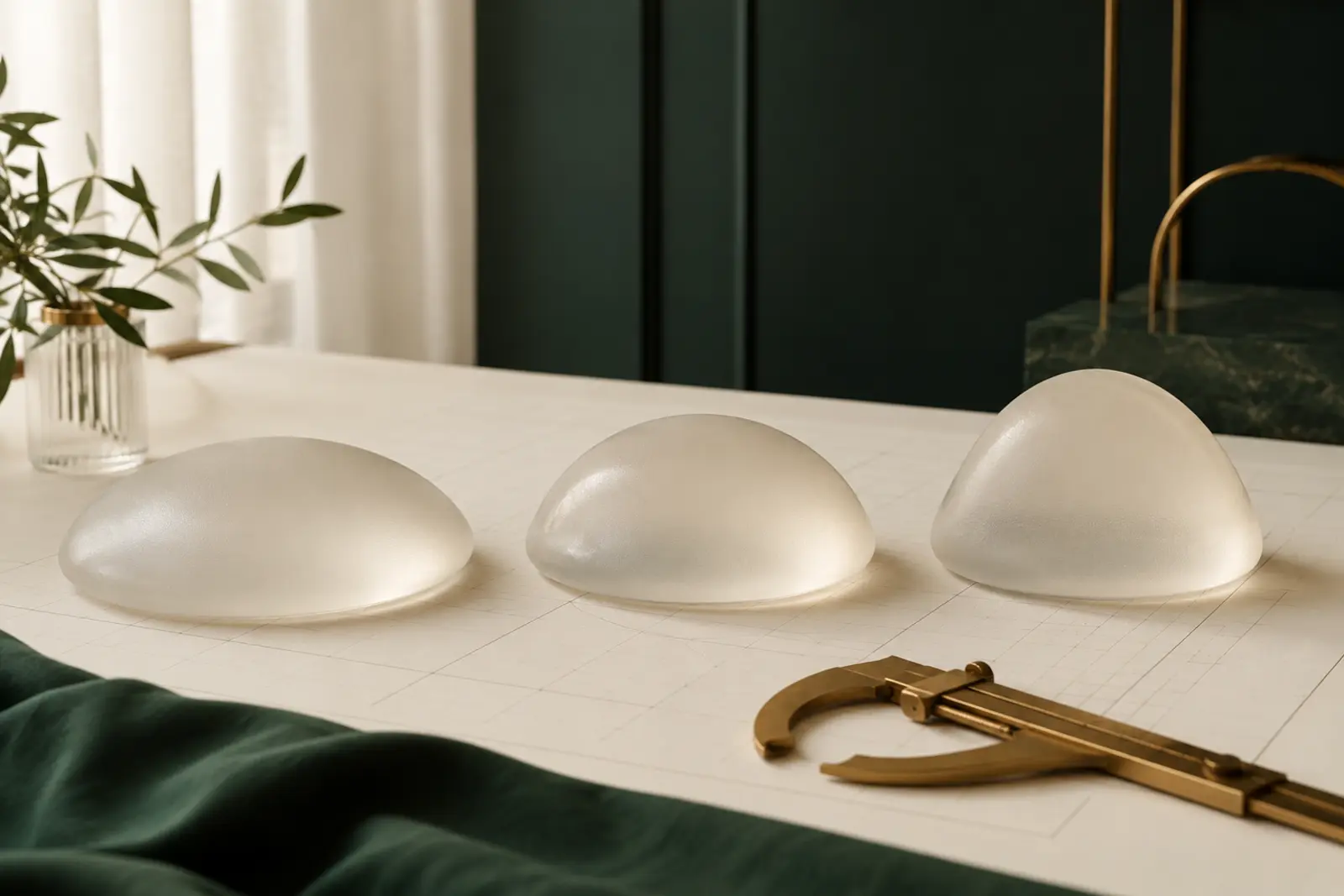
The implant and planning images in this article are illustrative; they do not show a real patient, a specific implant brand or a treatment result.
When choosing breast implants, concentrating only on “how many cc?” reduces a three-dimensional surgical plan to one number. Volume describes the amount of fill inside an implant. The same volume can be manufactured with different base widths, projections, heights and shapes. How any of those options behaves in the body also depends on the chest wall, existing breast tissue, skin envelope, inframammary fold, side-to-side differences and the planned surgical pocket.
Short answer: There is no universally correct number of cc. A suitable implant is selected from a range that reconciles a person’s goals with measurable anatomical limits, tissue coverage and the risks they are prepared to accept. Profile or volume alone cannot guarantee a “natural”, “large” or “good” result.
What does cc measure—and what does it not measure?
Implant volume is usually expressed in cubic centimetres (cc) or millilitres (mL); the units are equivalent for volume. The number alone does not reveal the external width, forward projection, height or a bra cup size. At the same volume, one model may have a wider base and lower projection while another has a narrower base and greater projection.
Volume still matters because it influences implant weight, tissue stretch and overall fullness. The problem is treating it as the only decision variable. Surgery is not an order for a chosen cc; it is an attempt to match implant geometry to the patient’s tissues within an agreed plan.
Why can the same volume look different?
Two implants can contain the same volume while distributing it differently. A wider, lower model occupies more of the breast footprint; a narrower model with more projection carries more of the volume forward. Implant height, upper-pole contour, edge transition and the size increments available within a product family also affect the geometry.
An implant is not placed on an empty, flat surface. The same device will not look identical on a narrow projecting rib cage and a broad flatter chest. Existing breast volume and its distribution contribute to the final contour. Copying another person’s cc therefore cannot reproduce their proportions.
Why is base width a starting measurement?
Base width is the horizontal dimension an implant occupies on the chest wall. The surgeon considers the native breast footprint, the distance from the sternum to the outer breast border, the inframammary fold and measurements on both sides. The aim is not numerical symmetry alone; it is a plan in which the implant edge can be supported by tissue and remain compatible with the breast boundaries.
An implant substantially wider than the available base may influence the risk of medial over-dissection, lateral displacement, axillary fullness, fold-control problems and palpable edges. A base that is too narrow may not fill the native footprint or create the intended central contour. These are not certain outcomes but trade-offs to discuss during examination.
Are projection and profile the same thing?
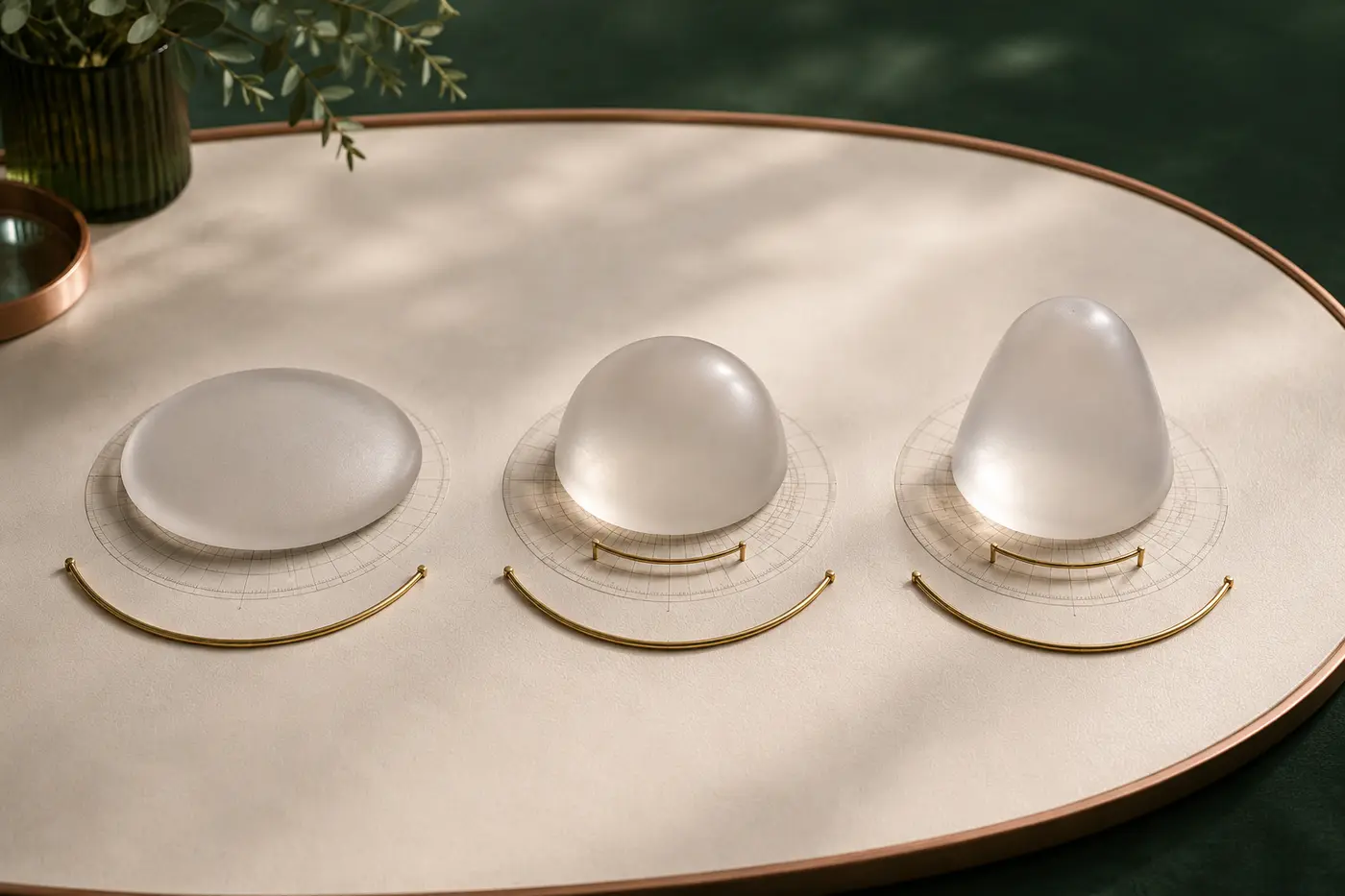
Projection is the distance from the implant base to its most forward point. Labels such as low, moderate, high and extra-high profile describe ratios within a manufacturer’s product family; the same label may not represent identical dimensions across manufacturers. Actual base diameter and projection are therefore more useful than the marketing name.
High profile does not mean better, automatically larger or more natural. At a given volume it may provide a narrower footprint and more forward projection. If the chest width, tissue or goal does not support that relationship, simply increasing profile does not create an appropriate result.
What do implant height, shape and contour change?
Even round implants are not always described by one base diameter; some product ranges offer different heights. Anatomical or teardrop-shaped implants distribute volume differently between the upper and lower poles, and rotation is a separate consideration. A round implant can also change its distribution when upright depending on gel properties and tissue pressure.
Rules such as “anatomical always looks natural” or “round always looks artificial” are inaccurate. The visible contour is created by the native breast, tissue thickness, pocket and implant geometry together. Suitability also depends on current regulatory status, product safety information and individual needs.
Fill, shell and surface are separate decisions
Implants may use silicone gel or saline and vary in gel cohesivity, shell construction and surface characteristics. Not every option is available in every country or at every time. Brand, model and surface should be discussed with current product information, regulatory notices, surgeon experience and the patient’s ability to maintain follow-up—not appearance alone.
Claims such as “the newest”, “the softest” or “lifetime guaranteed” do not replace medical counselling. The patient should receive and read the manufacturer’s patient information and retain the implant card recording the device, serial or lot details.
How do the chest wall and breast footprint affect planning?
Rib slope, sternum width, right-left chest projection and pectoral muscle shape influence the starting contour. Features such as scoliosis, pectus excavatum or pectus carinatum may be present, while milder asymmetries are common. An implant does not change the skeleton; it changes the soft-tissue contour over it.
Assessment is more than taking one line with a tape. The inner and outer breast borders, inframammary fold, nipple position and differences in height and volume are documented. Measurements narrow the range, but a formula cannot select an implant without assessing tissue quality and goals.
Why do tissue coverage and pinch assessment matter?
Skin, fat, breast tissue and—depending on the pocket—muscle cover the implant. The thickness and quality of this coverage influence whether an implant edge or rippling may be felt or seen. A surgeon may measure a tissue fold at specific points, but self-measurement at home cannot provide reliable implant selection.
With thin coverage, an implant that is large or wide for the base may be more visible or palpable. With thicker tissue, the external expression of implant geometry may be different. Pocket choice and selected use of fat grafting can be considered, but no technique eliminates visibility risk.
How do the skin envelope and inframammary fold set limits?
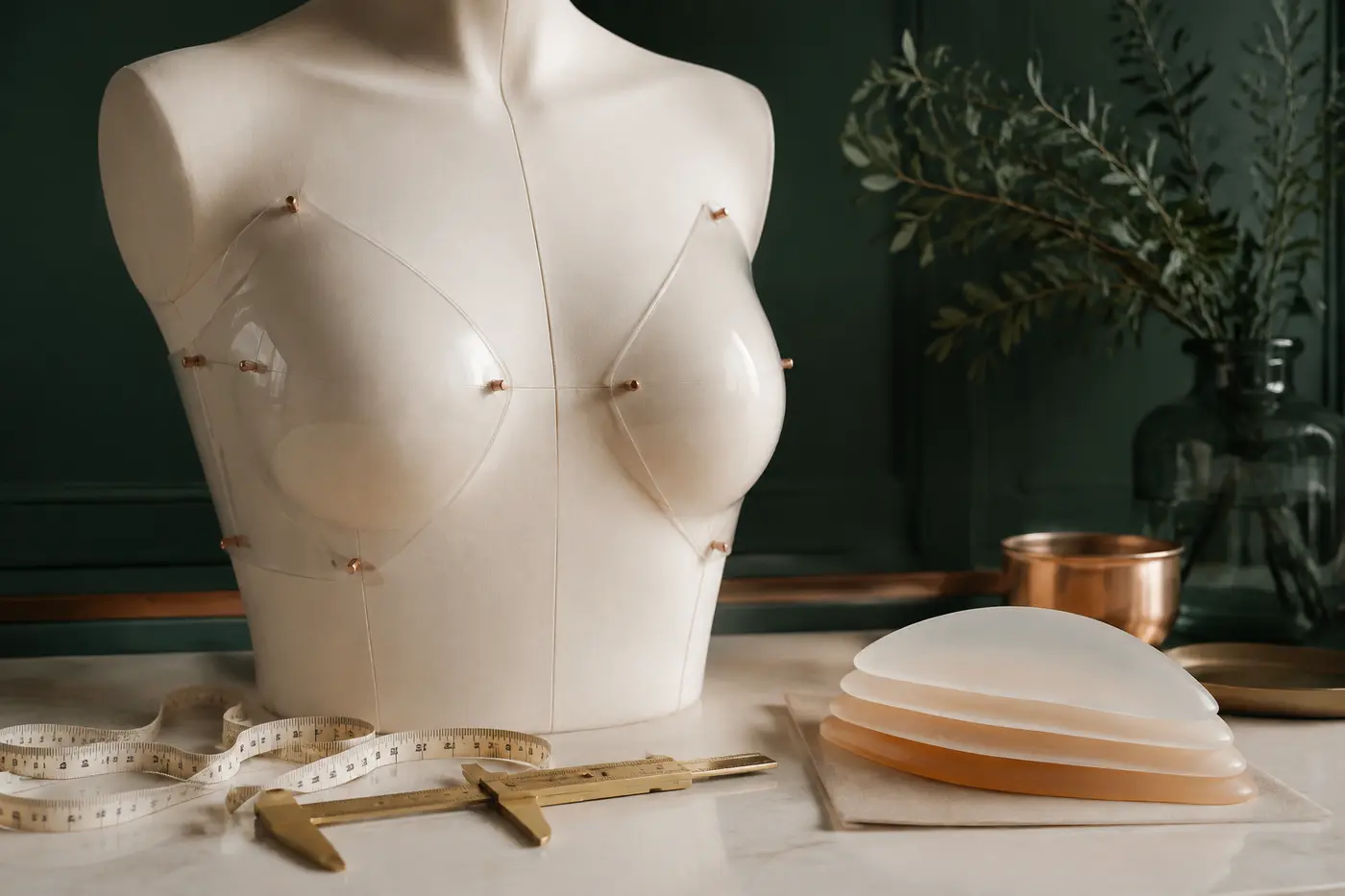
Skin elasticity, pregnancy and breastfeeding history, weight change, age, stretch marks and previous surgery affect how the breast envelope may carry an implant. Forcing a tight envelope to accept a very large volume and trying to fill a loose envelope with an implant alone create different concerns. Tissue continues to age and respond to gravity after surgery.
The inframammary fold is an important lower boundary. Depending on implant dimensions, the fold may be preserved, carefully repositioned or managed differently on each side. Excess release can contribute to inferior displacement or a double-bubble contour; inadequate adjustment can leave the implant high or compressed.
What do nipple position and existing asymmetry mean?
Most people have some difference in breast volume, footprint, fold level, nipple height or chest wall. Different implant volumes or profiles may reduce part of a volume discrepancy, but they cannot equalise every rib, nipple and skin difference. Some pre-existing asymmetries can become more noticeable once volume is added.
The starting asymmetry should be documented with measurements and clinical photographs. A different implant, fold adjustment, fat grafting or lift on one side may be considered. The aim is not millimetre-perfect symmetry; it is a more balanced plan with clear expectations about what may remain.
Why are words such as “natural”, “full” and “defined” insufficient?
These words have different visual meanings. For one person, natural means a gentle upper-pole slope; for another, it means noticeable fullness that remains proportionate in clothing. The surgeon and patient can use the same word but imagine different results, even if the measurements are accurate.
Goals are clearer when discussed as upper-pole fullness, forward projection, cleavage distance, side profile, clothing, sport and lifestyle. Images of results a patient likes and dislikes can assist communication, but they cannot promise a copy of another body.
Can bra cup size select an implant?
Bra sizing is not standardised across brands, styles and countries. The same person may wear different cups in different shops. “One cup larger” therefore has no fixed conversion to a number of cc. Bra fit after surgery also depends on breast width and chest circumference, not just volume.
A cup goal can provide context about everyday expectations; it is not a surgical measurement. Describing the desired change within the patient’s own proportions, supported by examples and sizing trials, is more informative.
Why is copying someone else’s implant size misleading?
A social-media result cannot be interpreted without knowing the person’s height, chest, starting tissue, exact device, pocket, camera angle and time since surgery. The same cc can appear smaller or larger on a different body. Filters, posing and supportive garments change perception further.
Reference images should be used to discuss preferences, not prescribe a model. Another person’s dimensions do not alter the recipient’s tissue limits. Examination, the device dimension chart, risk assessment and informed preference remain the basis of selection.
How accurate are external sizers and 3D simulation?
External sizers worn inside a bra can help a person experience an approximate change under clothing. They cannot reproduce a surgical pocket, muscle pressure, tissue coverage or healing. A sizer is a communication aid, not a result guarantee.
Three-dimensional simulation can compare ranges and clarify goals. Scan quality and software assumptions influence the rendering, and the system cannot precisely predict wound healing, tissue stretch or ageing. Simulation supplements examination; it does not choose the device on its own.
What trade-offs may accompany a larger implant?
As volume rises, implant weight and mechanical load on the tissues increase. An implant that is wide or heavy relative to the person’s base and coverage may influence tissue stretch, fold change, inferior or lateral displacement, edge palpability and rippling over time. There is no universal cc threshold at which these events occur.
Smaller is not automatically correct either: it may fail to meet the agreed goal or fill a lax envelope as expected. The decision is not a contest between the largest possible and the smallest safe device. It balances dimensions, tissue, preference and acceptance of long-term maintenance.
Does implant pocket affect size selection?
An implant may be placed in a subglandular, subfascial or muscle-related dual-plane pocket, among other variations. Labels do not describe every technical detail; the pocket is created for the individual anatomy. It can affect upper-pole coverage, animation with muscle contraction, recovery and some complications.
Muscle coverage may help conceal part of an implant in a thin patient, but movement or animation deformity can occur. Pocket choice is not an independent fix for unsuitable geometry. Implant, pocket and tissue should be planned together.
Are incision and pocket design independent of the implant?
Inframammary, periareolar and axillary incisions carry different considerations for access, scar visibility, sensation, contamination and future procedures. Device dimensions and type must allow the surgeon to create a controlled pocket and insert the implant without damage.
Pocket borders relate to base width. A pocket that is too tight may compress the implant; one that is too broad may allow displacement. Incision and pocket decisions should be explained in terms of tissue control and safe access, not scar length alone.
Can an implant alone correct sagging?
An implant adds volume and can fill a mildly deflated envelope, but it does not reliably remove substantial excess skin or elevate a low nipple. Trying to “fill” significant sagging with a very large implant can increase tissue load without achieving the intended nipple position.
Examination distinguishes volume loss from ptosis. A breast lift may be considered with an implant, or in selected cases as a staged operation. The combination adds variables and risk and should not be selected from photographs alone.
Could fat transfer or a hybrid approach be an alternative?
Autologous fat transfer may be considered for selected people who have a donor area and seek a more limited volume change. Some transferred fat will not survive; asymmetry, fat necrosis, cysts, calcification and repeat sessions are possible. A large single-session increase may not be safe or predictable.
In a hybrid plan, an implant provides the principal volume while fat is used selectively to soften transitions. It does not remove implant risks or guarantee fat survival. A breast augmentation consultation should explain the reason for implant, fat or combination rather than treating one option as universally superior.
How do implant-related risks influence selection?
In addition to bleeding, infection, wound problems, altered sensation, pain, asymmetry and anaesthetic complications, implant surgery carries risks of capsular contracture, rupture or deflation, malposition, rotation, rippling, palpability and further surgery. Risk is not identical for every patient or device.
Choosing an implant means accepting surveillance and possible future procedures, not only a desired appearance. FDA patient information states that breast implants are not lifetime devices and that the chance of additional operations increases with time. Local product labelling and follow-up guidance in Türkiye must also be applied.
Why should surface type and BIA-ALCL be discussed?
BIA-ALCL is not breast cancer; it is an uncommon lymphoma that can develop in the capsule or fluid around an implant. FDA information indicates that risk is higher with textured-surface implants than with smooth-surface devices. Estimated risk varies by product, texture, exposure duration and data source.
New late swelling, fluid, a mass or persistent pain around an implant warrants assessment. The purpose of counselling is informed follow-up, not alarm. Surface choice should be discussed with current regulatory information and the products legally available at the time.
What is known about symptoms called “breast implant illness”?
Some people report fatigue, cognitive problems, joint or muscle pain, hair loss and other systemic symptoms after receiving implants. Breast implant illness, or BII, is not currently a formal medical diagnosis; its cause and relationship to implants remain incompletely understood. The symptoms deserve evaluation, including consideration of other conditions.
Some patients report improvement after implant removal, but it is not possible to predict who will improve or by how much. Uncertainty should be stated plainly, without promising a definite cause or cure. New symptoms should be reviewed with the surgeon and relevant medical specialists.
Do implants last for life, and what follow-up is required?
Breast implants are not lifetime devices, but there is also no single year at which every implant must be replaced. Symptoms, examination, device type, imaging and patient preference determine management. Rupture, capsular problems, malposition or a change in goals may lead to future surgery.
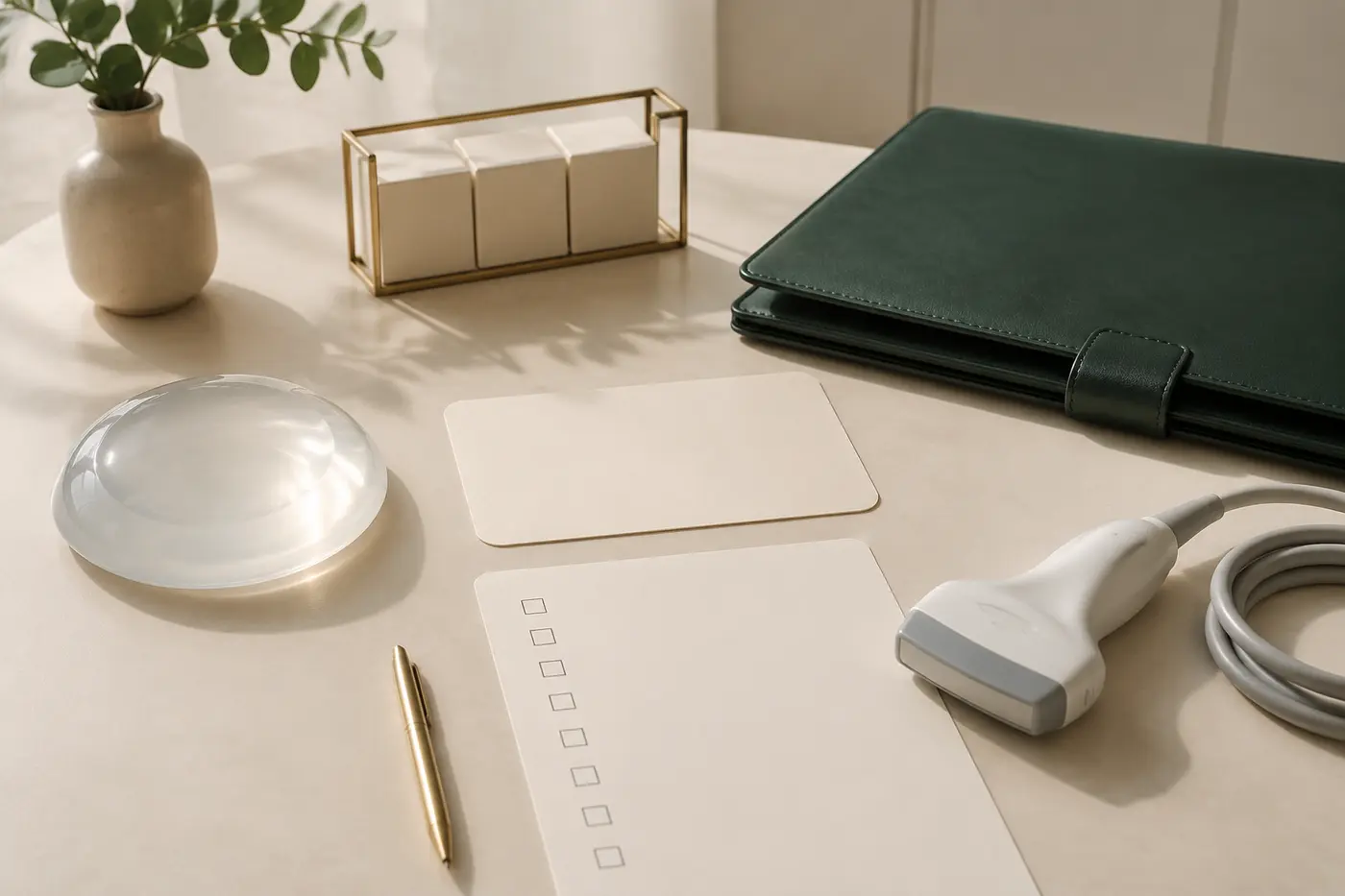
A silent rupture of a silicone gel implant may not be detected by examination. Current US FDA labelling recommendations describe an initial ultrasound or MRI at 5–6 years after surgery and then every 2–3 years for asymptomatic patients. This schedule must be adapted to the device label, national guidance in Türkiye and individual risk; symptoms may require earlier imaging.
Why do health assessment and breast screening matter?
Long-term conditions, previous operations, allergies, bleeding or clotting history, prescribed and non-prescribed medicines, supplements, pregnancy and breastfeeding plans should be discussed. Cigarettes, e-cigarettes and other nicotine sources can affect circulation and wound healing; any cessation plan should be agreed with the surgical team.
Breast imaging appropriate to age, symptoms, family history and the national screening programme should be completed before surgery when indicated. Implants do not prevent future mammography, but the radiographer must know they are present and additional views may be required. A new lump, discharge or skin change needs diagnostic assessment before cosmetic surgery.
Which variables belong in the implant-selection discussion?
| Variable | What it describes | What it cannot decide alone |
|---|---|---|
| Volume (cc/mL) | Amount of fill inside the device | Base, projection, cup or final appearance |
| Base width | Horizontal area occupied on the chest | How the tissues will cover it |
| Projection/profile | How volume is distributed forward | A “natural” or ideal result |
| Tissue coverage | Limits related to visibility and palpability | Removal of every risk |
| Skin and fold | Support and lower-boundary control | Future ageing or weight change |
| Goals and lifestyle | Preferred proportion and acceptable trade-offs | A change in anatomical limits |
A consultation may identify a reasoned range rather than one predetermined number. Sterile intraoperative sizers and observed tissue tension can influence the final choice within that agreed range. Unplanned improvisation is not the same as selecting among controlled alternatives; the possible range should be discussed before consent.
What should people travelling to Antalya plan?
Before an Antalya consultation, prepare a health history, medicine and supplement list, available mammogram or ultrasound reports, prior breast-operation notes and any implant card. An online consultation can support initial information and travel planning, but it cannot replace in-person assessment of tissue thickness, footprint and fold. Definitive implant selection should not be made from photographs.
People travelling from another city or country should confirm the licensed hospital, anaesthetic assessment, suitable stay in Antalya, early reviews, timing of flying or long journeys, emergency contact and follow-up after returning home. Tourism should not dictate the recovery timetable.
Twelve specific questions to ask at consultation
- What are the right and left breast-base measurements and starting asymmetries?
- What are the base width and projection of the proposed implant range?
- How would a wider or more projecting option at a similar volume change the plan?
- What limits does my tissue coverage create for palpability or rippling?
- Which pocket will be used, and why?
- Will the inframammary fold be changed?
- Is an implant enough, or why is a lift or fat transfer indicated or unnecessary?
- What is the exact manufacturer, model, surface and fill?
- Will I receive the patient information, warnings and implant card?
- Which short- and long-term risks are particularly relevant to me?
- What is the imaging and review plan for rupture and other complications?
- How would a revision or removal be managed?

Conclusion: fit comes before the number
When choosing breast implants, volume is necessary information but insufficient on its own. Base width and projection define device geometry; chest wall, native breast, skin envelope and tissue coverage define its limits; personal goals define the acceptable range of change. Product safety, surgical planning and long-term follow-up belong to the same decision.
A good consultation should produce more than a cc number. The patient should understand why a range is suggested, which trade-offs accompany the alternatives, which starting differences may remain and what future surveillance may be needed. That understanding is not a guarantee of outcome; it is the basis of an individual, informed decision.
References
- US Food and Drug Administration — Breast implants
- FDA — Things to consider before getting breast implants
- FDA — Risks and complications of breast implants
- FDA — Breast implant surgery and patient decision process
- FDA — Systemic symptoms reported with breast implants
- American Society of Plastic Surgeons — Breast augmentation consultation
- American Society of Plastic Surgeons — Breast implant profiles
- FDA — Breast implant patient labelling recommendations
- Republic of Türkiye Ministry of Health — Health promotion and information regulation
- FDA — Questions and answers about BIA-ALCL
FAQ
Frequently asked questions
Does the same implant volume look the same on everyone?+
What are implant base width and profile?+
Is a high-profile implant larger or more natural?+
Can a bra cup size determine implant size?+
Do implant sizers or 3D simulation show the exact result?+
Is the largest implant that fits the correct choice?+
Can an implant alone correct breast sagging?+
When should breast implants be replaced?+
Related information

Postoperative Recovery Guide · 17 min read
The First 30 Days After Breast Surgery: A Recovery Guide
Read article↗
Lift and Volume Decision Guide · 19 min read
Breast Lift or Implants? How the Difference Is Assessed
Read article↗
Pre-Consultation Checklist · 19 min read