Breast Surgery · Antalya
Breast Augmentation
A comprehensive guide to implants, fat transfer and, where appropriate, breast lift planning based on chest anatomy, tissue coverage, asymmetry, expectations and long-term follow-up.

Results of every surgical or invasive procedure may vary from person to person. You are advised to obtain detailed information from your doctor before the procedure.
The featured image on this page is illustrative; it does not show an actual patient or treatment result.
When researching breast augmentation in Antalya, focusing only on implant volume or online result photographs is not enough for responsible planning. Breast-base width, existing tissue thickness, skin elasticity, chest-wall anatomy, differences between the two breasts and personal expectations must be assessed together. The aim is not to reproduce one look for everyone, but to discuss feasible options, limitations and long-term follow-up within the person’s own anatomy.
In brief: Breast augmentation is not planned by answering “how many cc?” alone. Medical history, breast and chest measurements, tissue coverage, drooping, asymmetry, expectations and long-term follow-up all contribute to the individual plan.
What can breast augmentation change?
Breast augmentation, or augmentation mammoplasty, is an operation that may be considered to increase breast volume, reassess fullness lost after pregnancy, breastfeeding or weight change, and reduce selected volume asymmetries. Silicone implants are used most often. In suitable patients, transfer of the person’s own fat or a hybrid approach combining an implant with fat grafting may also be discussed.
Augmentation does not always correct significant drooping. If the nipple position is low or there is considerable excess skin, a breast lift may need to be assessed rather than simply adding volume. This distinction requires a clinical examination and cannot be settled from photographs alone.
Implants or fat transfer?
| Method | When might it be discussed? | Main planning limitation |
|---|---|---|
| Silicone implant | For medically suitable people seeking a more substantial and relatively predictable increase in volume | An implant is not a lifetime device; long-term follow-up and future surgery may be required |
| Fat transfer | For selected people seeking a more limited increase or refinement of specific contours and who have an adequate donor area | Some transferred fat may be reabsorbed, and more than one session may be needed for the intended volume |
| Hybrid approach | When an implant provides volume while fat grafting is considered useful for selected tissue transitions | Healing and risks at both the breast and fat-harvest area must be considered |
No single method is universally preferable. The decision depends on the intended change, body proportions, breast tissue, available donor fat, previous surgery and the individual’s preferences regarding implants.
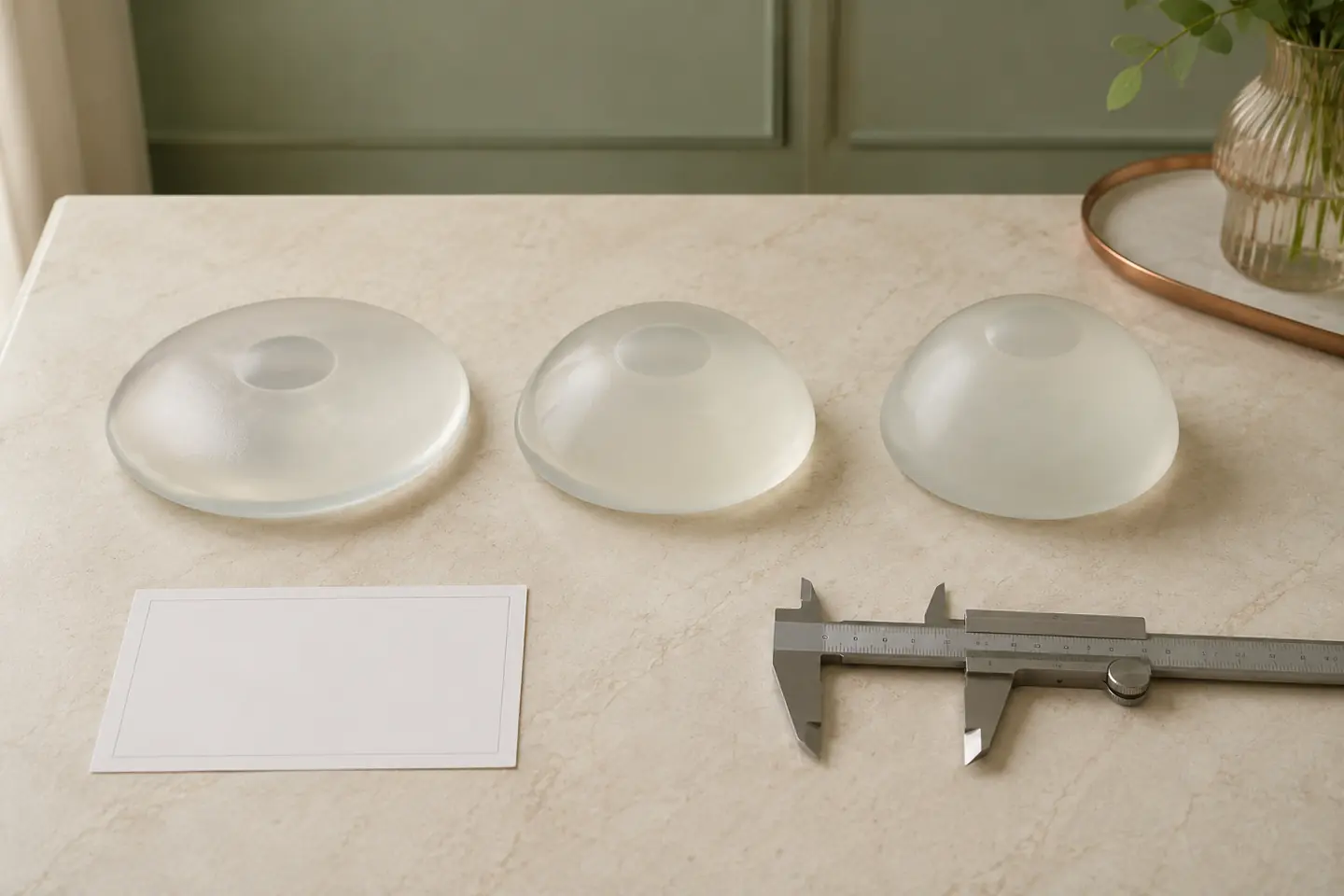
Why implant selection is not only about “how many cc”
Two implants with the same volume can have different base widths and projections. The same implant will also look different in people with different chest walls and tissue coverage. Volume is therefore only one part of planning.
Breast base and chest wall
The implant width should relate appropriately to the existing breast base and chest wall. A choice that is too narrow or too wide can affect the appearance of the cleavage area, outer border and inframammary fold.
Profile and projection
Profile describes how far an implant projects forward from the chest wall. Low-, moderate- and high-profile implants of the same volume can have different effects on the body. Selection is guided by base measurements and tissue capacity, not only by a request to look larger.
Tissue thickness and implant coverage
Where breast tissue and subcutaneous coverage are thin, concerns such as palpable implant edges or visible rippling become more relevant. The implant characteristics, placement plane and possible use of fat grafting are considered in this context.
Asymmetry and realistic expectations
Small differences in volume, fold position or nipple level are common. Different implants or additional procedures may reduce asymmetry, but mathematically perfect symmetry cannot be guaranteed when the chest wall and soft tissues differ.
What is assessed during consultation?
- General health, medication, allergies and previous operations
- Smoking and nicotine use, including factors that may impair wound healing
- Pregnancy, breastfeeding and planned major weight changes
- Breast examination appropriate to age and history, plus any existing imaging
- Breast-base width, chest wall, skin elasticity, tissue thickness and nipple position
- Differences in volume, folds and shape between the two sides
- The desired degree of volume change, upper-breast contour and effect on daily life
- Alternatives including implants, fat transfer, a lift or no operation
Three-dimensional simulation or implant sizers can support communication, but they cannot guarantee an exact result. Healing, swelling and changes over time cannot be predicted completely by a digital image.

How are the incision and implant position planned?
Incision position
Possible approaches include an incision in the breast fold, around the areola or in the armpit. The appropriate route depends on implant type and size, breast anatomy, previous scars and safe surgical access. Every incision leaves a scar. Its appearance over time is affected by genetics, nicotine exposure, infection and wound care, among other factors.
Implant placement plane
An implant may be placed beneath the breast tissue, in a plane related to the pectoral muscle or in another pocket tailored to the individual. Statements such as “under the muscle is always better” or “over the muscle always looks more natural” are not reliable. Tissue thickness, lifestyle, muscle anatomy, implant dimensions and the degree of drooping must be considered together.
Is augmentation alone enough?
Augmentation alone may be discussed when volume deficiency is the main concern, nipple position is appropriate and the skin envelope is suitable. If drooping or excess skin is significant, an implant and lift may be planned in one operation or in stages. A larger implant does not necessarily remove the need for a lift and may place more load on the tissues.
How does recovery progress after breast augmentation?
| Period | What may commonly occur | General approach |
|---|---|---|
| First 72 hours | Tightness, swelling, tenderness and temporarily limited arm movement | Prescribed medication, short walks, wound and bleeding observation, and no heavy lifting |
| First week | Continuing swelling and tightness; the two sides may change at different rates | Clinical review, advised support garment and gradual increase in light daily activity |
| Weeks 2–6 | Improving comfort while the tissues are still settling | Return to work, driving and exercise according to individual instructions |
| Following months | Further reduction in swelling and continuing change in breast and scar appearance | Planned reviews and adherence to long-term implant follow-up advice |
These periods are not a promise. Physical work demands, the chosen method, combined procedures and individual healing all affect the timeline. Rapid one-sided swelling, increasing pain, shortness of breath, uncontrolled bleeding, high fever or marked redness around a wound should prompt urgent contact with the surgical team.

Risks and long-term follow-up
All surgery carries risks such as anaesthetic complications, bleeding, infection, blood clots, wound-healing problems, noticeable scars, sensation changes and asymmetry. Implant-specific possibilities include capsular contracture, implant displacement, rippling, fluid collection, pain, rupture and the need for revision surgery.
Breast implants are not considered lifetime devices. Replacement is not automatically required simply because a fixed number of years has passed, but further surgery may become necessary if a problem develops or if the breast changes with pregnancy, weight fluctuation or ageing. It is important to keep the implant device card, continue routine breast-health checks and agree an imaging plan appropriate to the implant and clinical findings.
For silicone gel implants, the U.S. Food and Drug Administration recommends discussing a first ultrasound or MRI at 5–6 years after surgery even without symptoms, followed by imaging every 2–3 years. This is not an automatic schedule for every person: implant characteristics, symptoms, examination findings and the guidance applicable where care is provided should shape follow-up.
Current information about breast implant-associated anaplastic large cell lymphoma (BIA-ALCL) and other very rare cancers reported in the implant capsule should be included in informed discussion. Persistent one-sided swelling, a late fluid collection, hardness, a mass or pain arising long after surgery requires assessment. This information is provided to support informed consent and appropriate follow-up, not to create fear.
Pregnancy, breastfeeding and breast screening
Many people can breastfeed after implants, but no surgical technique can guarantee breastfeeding capacity. The incision, surgical method, individual milk-duct anatomy and the course of pregnancy can all have an effect. If pregnancy is planned soon, the timing of surgery should be discussed. Pregnancy and breastfeeding can change breast volume and shape even when the implant remains intact.
When mammography, ultrasound or other breast imaging is needed, the radiology team must be told that implants are present. An implant does not replace age- and risk-appropriate breast-cancer screening.
Who may be considered, and when might surgery be postponed?
Assessment may be appropriate for adults troubled by limited volume or loss of fullness, who have realistic expectations and are medically suitable for surgery. Surgery may be postponed in the presence of active infection, an unevaluated breast finding, an uncontrolled medical condition, pregnancy or breastfeeding. Nicotine use and any external pressure affecting the decision should also be addressed openly.
How are consultation, surgery and follow-up planned in Antalya?
A breast augmentation consultation in Antalya begins with the person’s goals and medical history, followed by physical examination, review of any indicated breast imaging and a comparison of reasonable alternatives. If surgery is chosen, the licensed healthcare facility, anaesthetic assessment, implant traceability details, discharge criteria and route for urgent contact should be clear in advance.
For people travelling from another city or country, planning should cover more than the operation date. The timing of in-person assessment, length of stay in Antalya, early reviews, travel or flying, and follow-up after returning home should be agreed with the surgical team. A remote preliminary discussion can help gather information, but it cannot replace examination and preoperative medical assessment.
Useful questions to ask during consultation
- Which of implants, fat transfer or a lift are being considered for my anatomy, and why?
- What are the proposed implant’s base width, profile, surface and placement plane?
- How much of my existing asymmetry is likely to remain?
- Where is the incision planned, and how will scar care be managed?
- How should return to work, driving, exercise, swimming and travel be staged?
- Which symptoms require urgent contact with the team?
- How should I keep my implant details and plan long-term examinations or imaging?
- What are the options if implant exchange, removal or other surgery is needed later?
Why is an individual plan created after examination?
Online information can help explain the available options, but it cannot establish surgical suitability. A breast augmentation plan in Antalya is created only after medical history, examination findings, any need for breast imaging, personal expectations and the feasibility of follow-up have been considered together. The purpose of consultation is not to persuade someone to undergo a particular procedure; it is to compare potential benefits, limitations and risks clearly, including the option of having no operation.
Medical responsibility for this page

This page is prepared for general information using current patient-safety sources and is medically reviewed by Op. Dr. Bahadır Çelik before publication. The review date shown on the page records the completed clinical review. The content does not replace examination, diagnosis, informed consent or an individual treatment plan.
References
- U.S. Food and Drug Administration — Risks and complications of breast implants
- U.S. Food and Drug Administration — Breast implant patient decision checklist and labelling guidance
- American Society of Plastic Surgeons — Breast augmentation
- American Society of Plastic Surgeons — Breast augmentation safety
- NHS — Breast enlargement (implants)
- Republic of Türkiye Ministry of Health — Regulation on health-service information and promotion activities
FAQ
Frequently asked questions
How many cc should my breast implants be?+
Must breast implants be replaced after 10 years?+
Is placement under or over the muscle better?+
Can breast augmentation and a lift be performed together?+
Can I breastfeed after implants?+
Can mammograms be performed with breast implants?+
When can I return to work after breast augmentation?+
What are the main risks of breast implants?+
Related information
 01
01Breast Lift Surgery
A comprehensive guide to nipple position, excess skin, existing tissue, scar patterns, implant decisions, recovery, risks and long-term change after a breast lift.
Read article↗ 01
01Breast Reduction Surgery
A detailed guide to symptoms associated with heavy breasts, tissue and incision options, scars, breastfeeding, recovery, risks and long-term follow-up.
Read article↗ 01
01Breast Asymmetry Correction
A detailed guide to causes, measurement, one- or two-sided methods, scars, recovery, risks and follow-up for breast asymmetry.
Read article↗