Breast Implant Follow-up Guide
When Should Breast Implants Be Replaced? Checks and Capsule
Understand the ten-year myth, silicone implant integrity screening, capsular contracture, and how exchange or removal is decided individually.
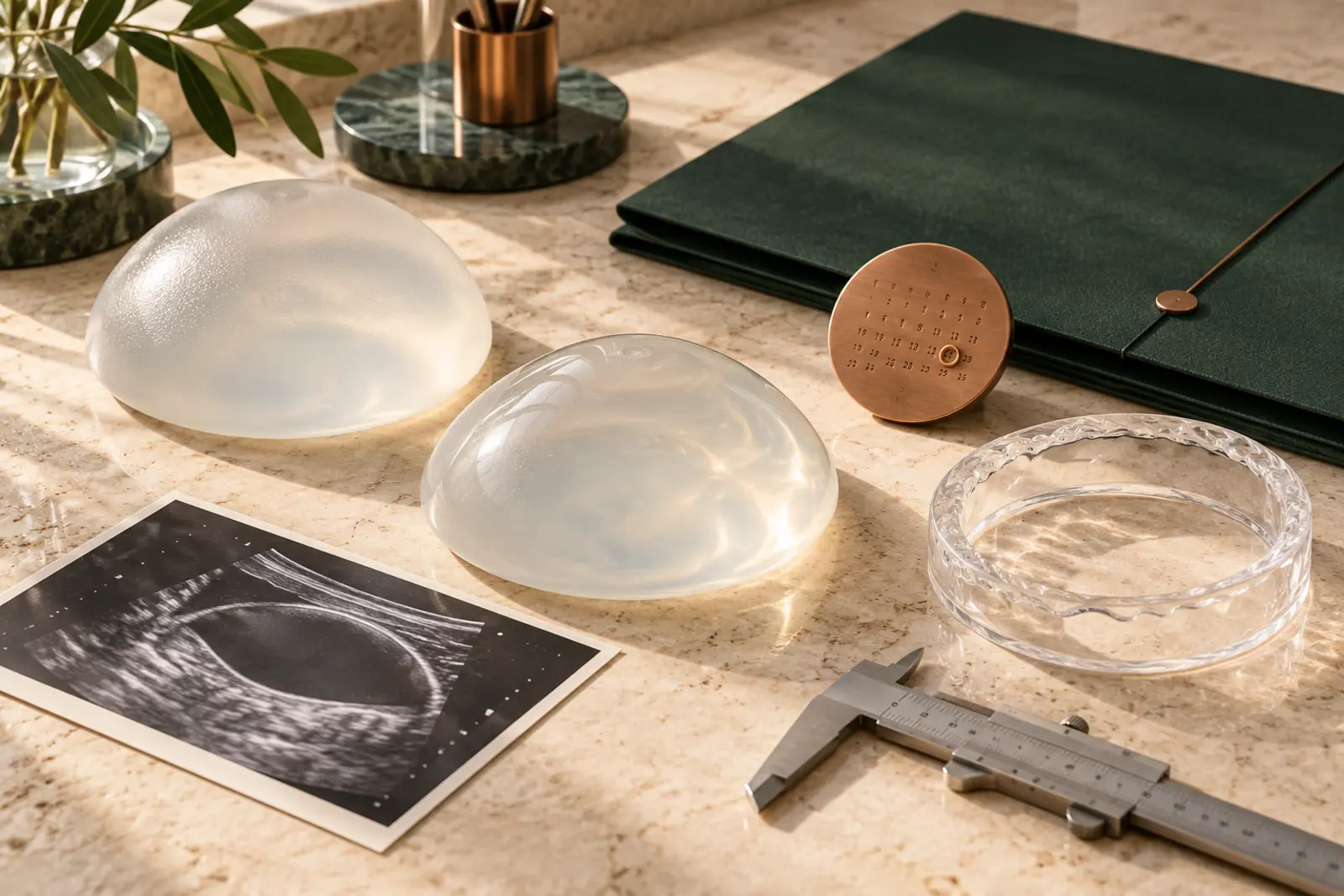
Image note: The editorial visuals on this page contain no patient, real operation or treatment result. They use conceptual objects to explain implant follow-up and decision-making.
Short answer: There is no universal rule that every breast implant must be replaced when it reaches ten years. An implant is not regarded as a lifetime device, but its calendar age alone is not an indication for surgery. Replacement or removal is considered by combining symptoms, examination, implant type and integrity, the capsule and pocket, natural breast tissue, appropriate imaging and the person’s goals. New swelling, firmness, pain, a shape change or a lump should be assessed without waiting for a routine appointment.
When should a breast implant be replaced?
There is no single expiry year for breast implant replacement. Some implants can be monitored for many years without a clinically important problem. Others may require earlier surgery because of rupture, capsular contracture, malposition, infection, rippling or a change in the person’s preferences. Implant age therefore matters, but it never answers the whole question.
The US Food and Drug Administration (FDA) states that breast implants are not lifetime devices and that the likelihood of complications increases the longer they remain in place. This does not mean that every implant must automatically be removed at a predetermined anniversary. A safer approach is to retain the device card and operation records, attend the recommended follow-up, and arrange an assessment when something changes.
Is replacement every ten years mandatory?
No. Ten years is often repeated online, yet it is not an expiry date that replaces examination and imaging. An implant that is intact, comfortable and consistent with the person’s goals may not need surgery simply because of its age. Conversely, a newer implant with confirmed rupture, significant contracture or persistent symptoms should not be left until an arbitrary date.
The fill, surface, manufacturer and model, previous operations and any relevant safety notice also matter. If the implant card is missing, the original operative note, hospital record and earlier imaging may help establish the device details. Planning should not be based on a guess about the product.
Which changes need clinical assessment?
Not every change leads to an operation. However, a timely plastic-surgery or breast-health assessment is appropriate when any of the following is new or progressive:
- A sudden or increasing difference in breast volume, shape or height,
- New firmness, tightness, pain or tenderness,
- Persistent swelling, a sensation of fluid or an underarm swelling,
- A newly visible implant edge, folding, rippling or displacement,
- Redness, warmth, fever, discharge or a wound that does not heal,
- A shape change or continuing discomfort after trauma,
- A new lump, skin retraction, nipple discharge or another breast-health change.
These findings do not diagnose rupture or a rare implant-related condition on their own. Infection, natural breast tissue, muscle, ribs, the capsule and the implant pocket can produce overlapping symptoms. A photograph or online checklist cannot replace a history, physical examination and targeted imaging.
What records should you bring?
The implant card may identify the manufacturer, model, fill, surface, volume and serial or lot number. The operation date, incision and implant plane, previous ultrasound or MRI reports, mammograms and any earlier complication are also useful. Accurate documentation becomes especially important if a product-specific safety communication is issued.
Note when the symptom began, whether it affects one or both sides, and whether there was trauma, pregnancy, breastfeeding, weight change, a new medicine or fever. The breast-aesthetics consultation checklist can help organise this information before your visit.
How is imaging surveillance planned for silicone implants?
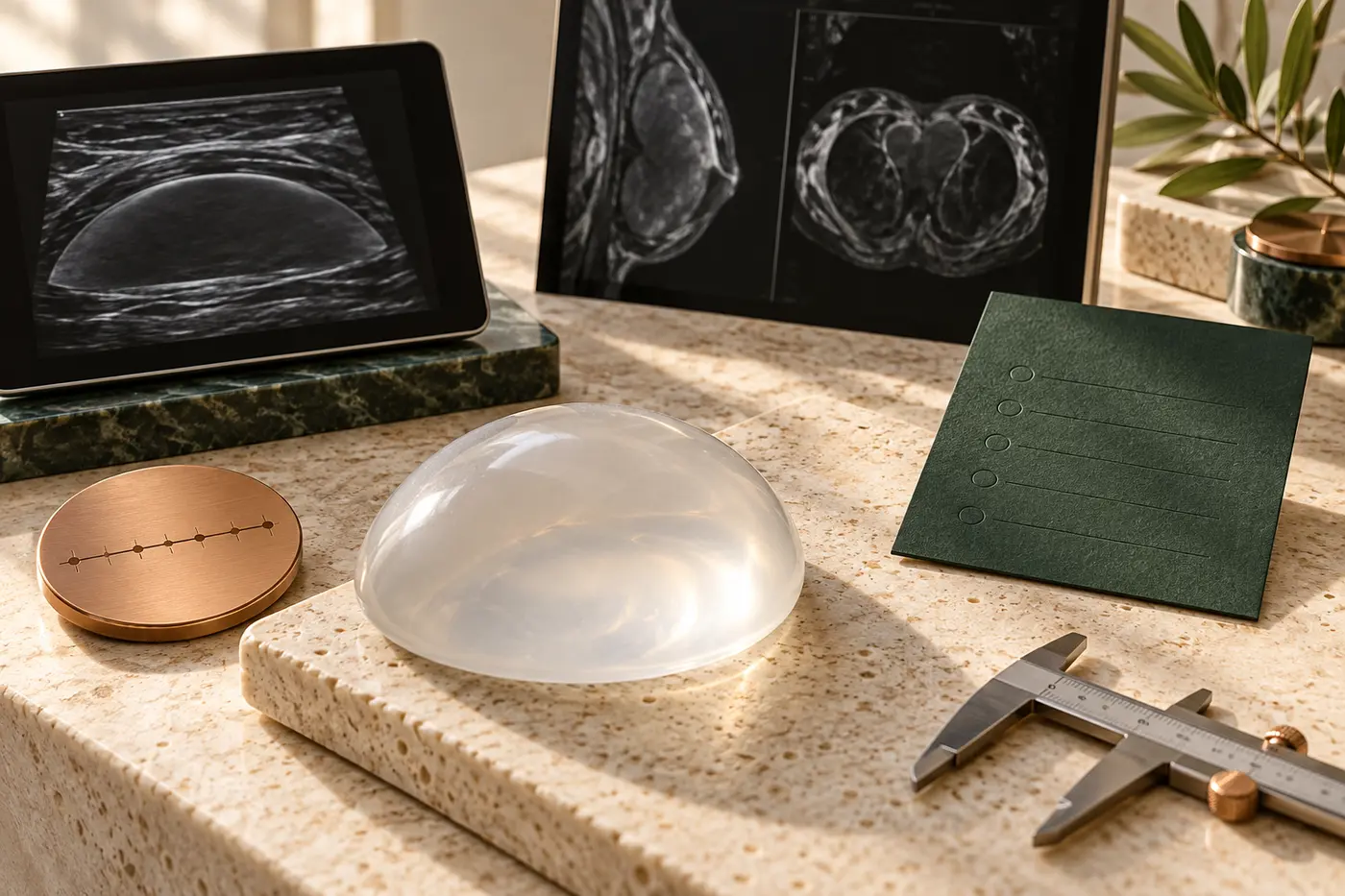
A silicone gel implant rupture can sometimes be clinically silent. Current FDA labelling guidance recommends that an asymptomatic person with silicone gel implants have a first ultrasound or MRI at five to six years after implantation and then every two to three years. MRI is recommended when symptoms are present or an ultrasound result for rupture is equivocal.
These intervals are US regulatory labelling recommendations, not an individual prescription for every country or patient. In Türkiye, the plan should be adapted to the manufacturer’s instructions, previous findings, age, the national breast-screening pathway, pregnancy and clinical judgement. Implant-integrity ultrasound or MRI does not replace breast-cancer screening. Always tell the mammography technologist that you have implants.
A saline implant rupture is usually noticed because the implant deflates. A silicone implant may retain its shape, and examination alone cannot always confirm integrity. At the same time, pain or a palpable fold is not automatically a rupture. The test should be chosen to answer a defined clinical question.
Does a ruptured implant always have to be replaced?
When rupture is confirmed, the implant type, whether silicone is contained within or extends beyond the capsule, symptoms, tissue condition and the person’s wish to continue with implants are considered. Removal of a ruptured implant is commonly discussed, but placement of a new implant is optional. Replacement, removal alone, pocket adjustment, capsule surgery, a lift or selected fat grafting may be considered in the same or a staged plan.
A suspicious phrase in an imaging report is not enough to choose an operation online. The images and report should be reviewed alongside the examination, and the implant should be distinguished from the natural breast tissue. The breast implant exchange and removal page outlines the broader planning framework.
What are the capsule and capsular contracture?
The body normally forms a thin layer of scar tissue, called a capsule, around every implant. The presence of a capsule is not itself a complication. If it thickens and tightens, the breast may feel firm, the implant may be pulled upward, the shape may become distorted or pain may occur. This is capsular contracture.
Clinical findings range from a soft, natural-looking breast to a firm, painful and visibly distorted breast. The Baker grading system helps communication but does not independently dictate treatment. New firmness may also require assessment for rupture, fluid, infection or another breast lump.
Must the entire capsule be removed with every implant?
No. Leaving the capsule, removing part of it, performing a total capsulectomy or attempting removal with the implant inside an intact capsule are different operations. When the capsule is thin and unremarkable, extensive removal may add bleeding, tissue injury, chest-wall injury and recovery burden without a clear benefit. A thick, calcified, infected or diagnostically concerning capsule may require a wider excision.
The term “en bloc” is sometimes presented online as mandatory for every explant. In practice, an oncological indication, whether the capsule can be separated safely and the expected benefit versus risk determine the extent. The surgeon should explain why a particular capsule procedure is proposed after examination and imaging.

Why does late swelling matter?
Persistent one-sided swelling, a fluid collection, a lump or pain that begins months or years after surgery should not be dismissed as normal ageing of an implant. Many causes are benign, but infection, trauma, rupture and rare implant-associated diseases need to be distinguished. Assessment often begins with examination and ultrasound; fluid may require aspiration and specific laboratory tests.
Breast implant-associated anaplastic large cell lymphoma (BIA-ALCL) is not breast cancer. It is a rare lymphoma associated with the fluid and capsule around an implant, with risk linked particularly to certain textured surfaces. The FDA does not recommend routine preventive removal of every implant in people without symptoms solely because of anxiety; the exact device and clinical findings should be reviewed individually.
Regulators have also reported very rare squamous cell carcinoma and other lymphomas in the implant capsule. Rarity is not a reason to ignore persistent symptoms, while a safety notice is not a reason to attribute every symptom to these diagnoses. A targeted diagnostic pathway avoids both delay and unnecessary alarm.
How do monitoring, exchange and removal compare?
| Option | When it may be discussed | Main trade-off |
|---|---|---|
| Monitoring | No concerning symptoms and reassuring examination/integrity assessment | Ongoing follow-up and the possibility of later surgery remain |
| Implant exchange | Rupture, contracture, pocket/position problem or a wish to continue with implants | The new device is also not lifetime and carries surgical risks |
| Removal alone | No wish for another implant, a complication or personal preference | Volume loss, laxity, indentation or a shape change may follow |
| Removal plus lift | Substantial skin excess or nipple descent | Longer scars and additional circulation/sensation risks |
| Removal plus fat grafting | Selected, limited volume or contour goals | Variable fat retention, donor-site effects and possible repeat sessions |
This table is not a treatment selector. One side may be ruptured while the other is intact, or there may be thin tissue, ptosis and chest-wall asymmetry. Both breasts do not necessarily require the same procedure.
Is the same implant size used during exchange?
Not necessarily. In addition to the old volume, the footprint, profile, shell characteristics, current pocket, tissue thickness and skin change over time are measured. Two implants with the same stated volume may not create the same shape. A larger implant does not automatically correct lax skin and can increase the load on the tissues.
If another implant is planned, volume, profile and base width should be reconsidered. The submuscular, subglandular or dual-plane choice is not simply copied from the first operation; capsule and muscle movement may alter the decision. See the implant-plane guide for a detailed comparison.
What may the breast look like after removal?
The appearance depends on implant size and duration, natural tissue, skin elasticity, pregnancy and weight history, the capsule and any accompanying procedure. Loss of volume, upper-pole emptiness, wrinkling, asymmetry or ptosis can occur. The early appearance is not final because swelling subsides and tissues adapt.
A lift can be performed at the same operation or in stages, and neither strategy is universally superior. A staged plan may clarify the true tissue volume and protect blood supply in selected thin or previously operated breasts. Some people accept the appearance after removal alone; an additional aesthetic procedure is not mandatory.

What are the principal surgical risks?
Possible risks include bleeding, infection, fluid collection, delayed wound healing, scars, altered sensation, pain, asymmetry, contour irregularity, implant malposition, recurrent contracture, rupture and further surgery. A more extensive capsulectomy may change the risk of bleeding and injury to adjacent tissues. If a lift or fat grafting is added, its specific risks also form part of consent.
Nicotine use, poorly controlled diabetes, certain medicines, a history of thrombosis, radiotherapy and multiple previous operations affect personal risk. Disclose prescribed medicines, supplements and herbal products; do not stop them using an internet list without advice from the treating team.
How long are recovery and return to work?
Recovery depends on the actual procedure. A straightforward implant exchange is not equivalent to a wide capsulectomy combined with a lift. Tightness, swelling, bruising and sensitivity with arm movement are common initially. Follow the individual written instructions for dressings, support bra, showering, driving, sleeping position and work.
The shape is not final in the first weeks. Rapid one-sided swelling, uncontrolled pain, breathlessness, fever, spreading redness or wound discharge needs urgent contact. The first 30 days after breast surgery guide provides a general timeline, but your surgical team’s instructions take priority.
What should international patients plan in Antalya?
A remote preliminary consultation can organise records and goals, but it cannot determine capsule firmness, tissue thickness or pocket anatomy. Send the implant card and imaging in advance and allow time in Antalya for repeat imaging or a breast-health opinion if required.
Return travel must remain flexible around drains, early review and any additional assessment. The earliest safe flight is not identical for everyone. Compressing revision surgery into a holiday itinerary can make continuity of care difficult if a complication develops.
Questions to ask at the consultation
- Have the manufacturer, model, surface and fill of my implant been verified?
- Is my concern most likely related to the implant, capsule, pocket or natural tissue?
- Why do I need—or not need—ultrasound, MRI or breast-health imaging?
- What are the personal benefits and limits of monitoring, exchange and removal alone?
- Which part of the capsule would be removed, why, and what extra risk does that add?
- If another implant is used, why would its size, base, profile or plane change?
- For laxity or volume loss after removal, what can be done now and what is safer in stages?
- Which postoperative changes require immediate contact?
Op. Dr. Bahadır Çelik’s assessment approach
In an assessment with Op. Dr. Bahadır Çelik, implant age alone is not treated as an operation indication. The device and operative records, timing of symptoms, examination of both breasts, capsule and pocket findings, tissue quality and appropriate imaging are reviewed together. A medical question that requires investigation is separated from an aesthetic preference.
The plan explains the rationale and limits of monitoring, implant exchange, removal alone, capsule surgery, pocket adjustment, lift or fat grafting. The aim is not to promote one technique, but to create an auditable decision that avoids unnecessary surgery without delaying necessary evaluation.

Conclusion: follow the findings, not a calendar myth
Implant age is useful information, but it is not a replacement date. An implant without symptoms still needs appropriate follow-up; silicone gel implant integrity imaging and routine breast-health screening must be planned as separate, complementary tasks. New pain, firmness, swelling, a shape change or a lump brings the assessment forward.
The choice between exchange and removal is shaped by implant integrity, the capsule and pocket, natural tissue, risk and the person’s wish to continue with an implant. Before sending a contact request, prepare your implant card, operative record and latest imaging so the review can be safer and more efficient.
Medical note: This article is general health information, not a personal diagnosis or operation recommendation. Seek timely medical care for sudden swelling, fever, spreading redness, rapidly increasing pain, discharge, a new lump or a persistent one-sided change.
References
- US FDA — Risks and complications of breast implants
- US FDA — Things to consider before and after breast implants
- US FDA — Implant labelling and silicone-rupture screening recommendations
- US FDA — Questions and answers about BIA-ALCL
- US FDA — Safety communication on SCC and lymphomas in the implant capsule
- ACR — Breast Implant Evaluation Appropriateness Criteria, 2025 update
- American Society of Plastic Surgeons — Breast implant removal
- American Society of Plastic Surgeons — Implant removal risks and safety
- NHS — Breast enlargement, implant lifespan and complications
- Republic of Türkiye Ministry of Health — Regulation on healthcare promotion and information
FAQ
Frequently asked questions
Must breast implants be replaced every ten years?+
Which symptoms should bring an implant check forward?+
When are ultrasound or MRI used for silicone implants?+
What is a silent implant rupture?+
Must the entire capsule be removed with every implant?+
Must a ruptured implant be replaced with another implant?+
Is the same volume used during implant exchange?+
What does late swelling around an implant mean?+
Related information
Implant Planning Guide · 16 min read
Why Volume Alone Is Not Enough When Choosing Breast Implants
Read article↗
Postoperative Recovery Guide · 17 min read
The First 30 Days After Breast Surgery: A Recovery Guide
Read article↗
Lift and Volume Decision Guide · 19 min read