Breast Health and Preoperative Imaging
Mammogram Before Breast Surgery: Is It Needed?
Learn how age, risk, symptoms and screening status determine whether ultrasound, mammography or MRI is appropriate before breast surgery.
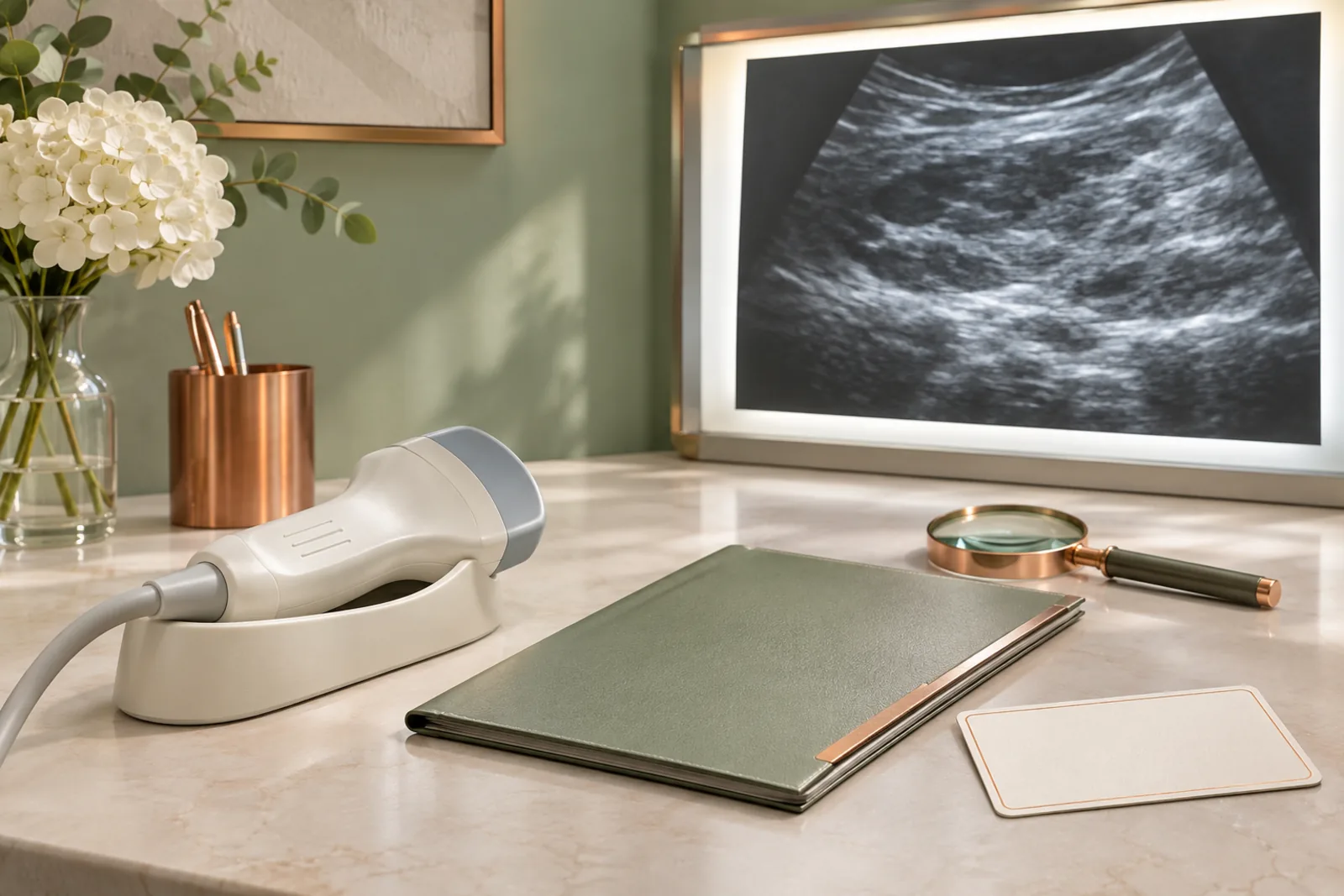
Image note: The editorial images on this page show no patient or real diagnostic study. They explain ultrasound, mammography, medical history and record preparation through patient-free clinical compositions.
Short answer: A new mammogram or ultrasound is not automatically required for everyone planning aesthetic breast surgery. The appropriate examination depends on age, the national screening programme, personal and family history, examination findings, new symptoms and the date of previous imaging. If routine screening is due, it should be brought up to date. If there is a lump, discharge or skin change, diagnostic assessment must come before elective surgery. Ultrasound and mammography are not simple substitutes; they answer different clinical questions.
First separate three different purposes
The answer to “Do I need imaging?” depends on why it is being requested. The first purpose is routine screening in a person without symptoms, according to age and risk. The second is diagnostic imaging used to explain a lump, discharge or another finding. The third is implant evaluation, which investigates a specific question about an existing implant or surrounding tissues.
These are not interchangeable. Considering aesthetic surgery does not automatically create a reason for additional mammography. Conversely, if screening is overdue or a suspicious finding exists, it is not appropriate to assume that it can simply be assessed during surgery.
How is routine screening considered in Türkiye?
The Turkish Ministry of Health population programme recommends mammography every two years for women aged 40–69. Age is not the only factor: family history, previous biopsies, chest radiotherapy, genetic risk and earlier imaging results may alter an individual plan.
Intervals published by international organisations may differ. A single age threshold found online should therefore not be applied to everyone without considering the national programme and personal risk. If a recent mammogram or ultrasound remains current, repeating the same test merely because surgery is planned may not be useful.
When may breast ultrasound be used?
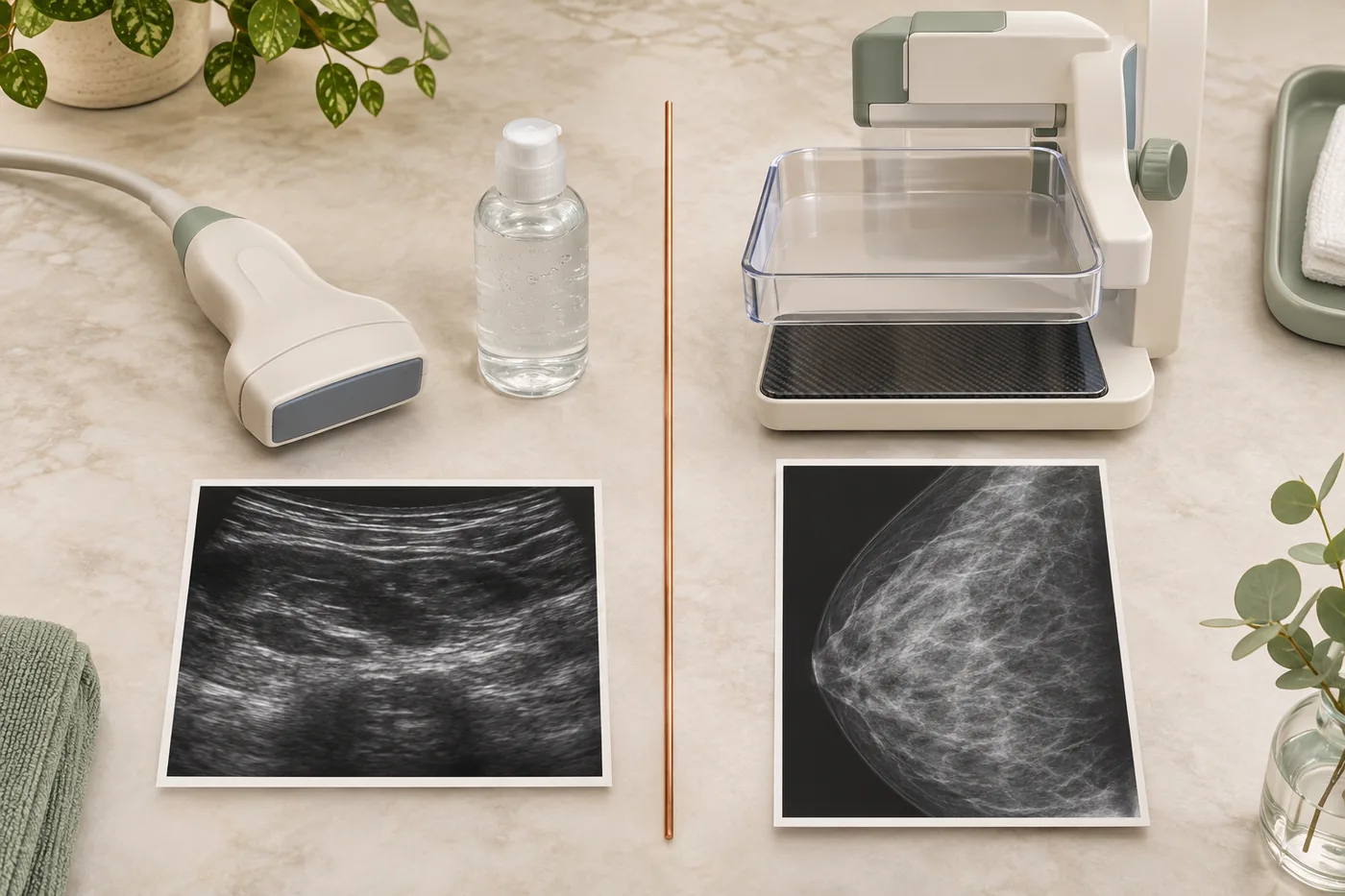
Ultrasound uses sound waves and does not involve ionising radiation. It may be used in younger or dense breast tissue, to assess a palpable area, distinguish cystic from solid findings, or complete information from another study. The statement “there is no radiation, so ultrasound is enough for everyone” is nevertheless incorrect.
Its role depends on age, symptoms, examination and radiological assessment. It does not automatically replace screening mammography; in some situations it is an adjunct and in others it may be the first diagnostic study.
When may mammography be used?
Mammography evaluates breast tissue with low-dose X-rays. Screening mammography looks for early abnormalities in a person without symptoms who falls within a screening programme. Diagnostic mammography may use additional views to examine a symptom, physical finding or area previously detected on imaging.
Aesthetic surgery does not remove the need for age- and risk-appropriate screening. At the same time, ordering routine mammography for every young, low-risk and asymptomatic patient solely because surgery is planned can lead to unnecessary follow-up tests and biopsies. The correct approach is to select imaging that matches current guidance and the individual clinical question.
Does everyone need MRI?
No. Breast MRI is not the first routine test for every person preparing for elective breast surgery. It may be considered in selected circumstances such as high cancer risk, a finding not resolved by other imaging, or a specific question about implant integrity. Whether contrast is used and the imaging protocol depend on that question.
More detailed imaging is not automatically the best first test. Unnecessary MRI may reveal incidental findings and generate further procedures without improving the original decision. Radiology and the relevant clinicians should determine the sequence.
Which symptoms require diagnostic assessment?
- A newly noticed or enlarging one-sided lump,
- Spontaneous nipple discharge, particularly bloody or from one duct,
- New nipple inversion or persistent crusting,
- Skin dimpling, peau d’orange, persistent redness or thickening,
- A new lump in the armpit,
- Unexplained rapid change in shape or volume on one side,
- A previous imaging finding for which follow-up was recommended.
Many of these findings may have benign explanations, but they should be clarified before an elective aesthetic operation. Breast surgery, radiology or another appropriate specialty may need to take priority over aesthetic planning.
Why is routine preoperative mammography not right for everyone?
Outside screening guidance, performing mammography solely because an elective breast operation is planned may create more downstream investigation than benefit in a young, low-risk and asymptomatic person. A recent study reported persistent overuse of preoperative mammography in low-risk breast-reduction patients under 40, with some examinations leading to further imaging or biopsy.
This does not mean that preoperative imaging is unnecessary. The message is more precise: imaging should be ordered for age, screening status, risk, symptoms and examination findings. It should neither be automatic for everyone nor omitted when genuinely indicated.

Why do previous studies matter?
Earlier mammograms, ultrasound or MRI allow comparison over time. The images themselves are useful when available, not just the written report. If you have had a biopsy, breast operation, infection or trauma, bring the pathology and operative records as well.
If a report recommends “follow-up in six months,” explain whether that review was completed. When a recommended follow-up remains unresolved, completing the radiological pathway is safer than accelerating elective surgery.
Can imaging change the operation?
Imaging is usually performed to answer a separate breast-health question, not to choose the aesthetic technique. However, an unresolved finding may change timing, tissue pathology planning or the need for coordination with another specialty.
Tissue removed during breast reduction may be sent for histopathological examination, but this does not replace indicated preoperative imaging. The same principle applies to augmentation and lift: when a suspicious finding exists, diagnosis should be completed before elective aesthetic treatment.
Can a person with implants have mammography?
Yes. People with breast implants should continue breast cancer screening appropriate to their age and risk. The mammography facility must be told about the implants when the appointment is made so that suitable views and technique can be used. Implants are not a reason to stop screening.
Cancer screening and screening for implant rupture are different. Mammography may indicate some implant problems, but ultrasound or MRI may be selected separately for silicone implant integrity. Those with existing implants can read our guide to implant follow-up and replacement.
What should be brought to consultation?
- Recent mammography, ultrasound or MRI reports and image files when available,
- Previous biopsy and pathology results,
- Reports from earlier breast operations and the implant card,
- Family history of breast or ovarian cancer, including age at diagnosis,
- Hormones, medicines and supplements currently used,
- A timeline of a new lump, discharge, pain or skin change,
- Follow-up dates recommended by the radiologist.
The consultation preparation checklist can help organise these records and questions.

Does the approach differ for augmentation, lift and reduction?
The core principle remains the same: complete the necessary screening or diagnostic assessment first, then establish the aesthetic plan. Breast augmentation, breast lift and breast reduction are different operations, but a suspicious finding should not be dismissed under any aesthetic heading.
Imaging may arise more often before reduction according to age, history and examination. Before augmentation, a baseline study may be useful for selected patients. Yet the procedure name itself does not choose the test; personal risk and the clinical question do.
Op. Dr. Bahadır Çelik’s assessment approach
Consultation with Op. Dr. Bahadır Çelik begins with health history, family history, breast symptoms and previous imaging. If screening is due for age or risk, or examination reveals a finding that needs explanation, the appropriate radiology or specialty assessment is completed before elective surgery is finalised.
The aim is not to hand every patient the same test list. It is to select the necessary examination for the right reason and at the right time. Current studies are not needlessly repeated, incomplete follow-up is completed and the aesthetic plan is then built on a safer foundation.

Conclusion: the right study for the right person
The decision to obtain ultrasound or mammography before aesthetic breast surgery depends more on screening status, risk and clinical findings than on the desire for surgery itself. Avoiding unnecessary testing in a low-risk, asymptomatic person and completing necessary assessment in someone with overdue screening or a suspicious finding are two parts of the same safety approach.
Bring previous images and reports when sending an information request. This page is not a personal screening or diagnostic recommendation; the appropriate method is chosen after examination and relevant medical assessment.
Medical note: If you notice a new lump, spontaneous or bloody discharge, nipple inversion, skin dimpling or thickening, an armpit lump or rapid one-sided change, seek appropriate medical care without waiting for an aesthetic consultation.
References
- Republic of Türkiye Ministry of Health — National breast screening programme
- American Society of Plastic Surgeons — Breast reduction preparation
- American Society of Plastic Surgeons — Consultation and preparation
- USPSTF — Breast cancer screening recommendation
- American College of Radiology — Breast imaging and screening resources
- Overuse of preoperative mammography in breast reduction surgery
- Discussion of preoperative mammography before reduction mammaplasty
- U.S. FDA — Mammography Quality Standards frequently asked questions
- U.S. FDA — Mammography information for patients
- Republic of Türkiye Ministry of Health — Regulation on health promotion and information
FAQ
Frequently asked questions
Does everyone need a mammogram before aesthetic breast surgery?+
Can breast ultrasound replace mammography?+
When is routine mammography recommended in Türkiye?+
Is MRI required before breast surgery?+
Should I bring my previous imaging?+
Can someone with implants have a mammogram?+
What happens if imaging finds something suspicious?+
Does pathology after breast reduction replace preoperative imaging?+
Related information
Implant Planning Guide · 16 min read
Why Volume Alone Is Not Enough When Choosing Breast Implants
Read article↗
Postoperative Recovery Guide · 17 min read
The First 30 Days After Breast Surgery: A Recovery Guide
Read article↗
Lift and Volume Decision Guide · 19 min read